
In this episode
- The Alliance's work with LGBTQ youth — clinical services, care coordination, education, and policy change
- Key issues facing LGBTQ youth including safety, homelessness, and intersecting forms of oppression
- How The Alliance builds affirming, youth-led community grounded in resilience
- The harm done by social workers and clinicians who fail to challenge heterosexism and cisgenderism
Meet the guests
Pauline Green, Esq., is Executive Director and Mark Houston, LCSW, is Clinical Manager of the Alliance for GLBTQ Youth in Miami, Florida. The Alliance works with LGBTQ youth in Miami-Dade County.
Links and resources
Key Takeaways
Safety comes first, which means knowing who a young person is out to before involving anyone
Many young people choose couch surfing or cars over shelters because shelters can be unsafe
Young people experiencing homelessness arrive already resilient, so the question is what services they actually want
Clients will always teach you something, but they should not have to teach the basics of their community
Stay In The Know
Join our email list and you’ll get our newsletter (In The Know), new podcast episode announcements, course releases, and early access when new offerings drop. No noise. Just the work.
SUBSCRIBETranscript
Welcome to “Doin’ The Work: Frontline Stories of Social Change” where we bring you stories of real people working to address real issues. I am your host, Shimon Cohen.
In this episode I talk with Pauline Green, Executive Director and Mark Houston, Clinical Manager of the Alliance for GLBTQ Youth in Miami, Florida. They discuss the multiple aspects of the work they do with LGBTQ youth in Miami-Dade, County such as care coordination, clinical services, community education, training for service providers and educators and policy change. We explore some key issues affecting LGBTQ youth; particularly safety and homelessness as well as multiple forms of oppression such as homophobia, transphobia and racism.
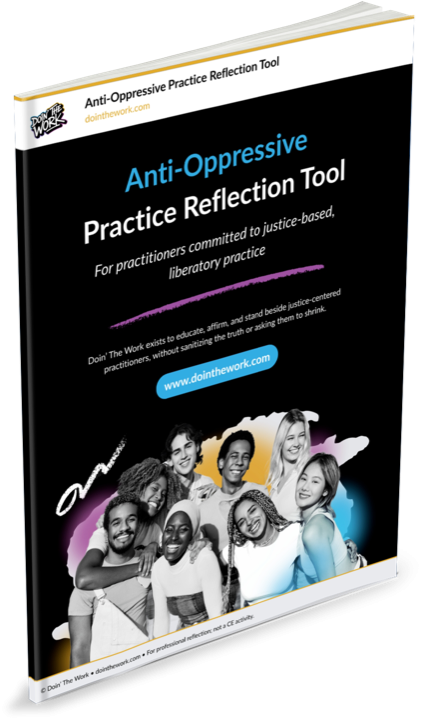
Free Anti-Oppressive Practice Reflection Tool
Understand how systems of power, privilege, and oppression shape our lives, our clients’ realities, and our professional decisions.
DOWNLOAD THE FREE TOOLCheck Out The Full Transcript
Shimon Cohen:
Welcome to “Doin’ The Work: Frontline Stories of Social Change” where we bring you stories of real people working to address real issues. I am your host, Shimon Cohen.
In this episode I talk with Pauline Green, Executive Director and Mark Houston, Clinical Manager of the Alliance for GLBTQ Youth in Miami, Florida. They discuss the multiple aspects of the work they do with LGBTQ youth in Miami-Dade, County such as care coordination, clinical services, community education, training for service providers and educators and policy change. We explore some key issues affecting LGBTQ youth; particularly safety and homelessness as well as multiple forms of oppression such as homophobia, transphobia and racism.
Mark and Pauline talk about how the Alliance builds community in a youth-led affirming space that builds on the resiliency many LGBTQ youth already possess. We discuss the harm that can be done by social workers and clinicians who do not challenge heterosexism and cisgenderism. Pauline and Mark also share how they got into this work. I hope this conversation inspires you to action. Hey Pauline, Hey Mark, thanks so much for coming on the podcast. And just to kind of get things started could you both talk about what you currently do?
Pauline:
Sure, thank you so much for having us Shimon, we're really super excited to be here. So as you noted, I am the Executive Director of the Alliance for GLBTQ Youth. The Alliance serves, nurtures and empowers LGBTQ youth across Miami-Dade. We do this through providing direct services to our young people and their families. This is in the clinical space both as care coordination and individual counseling. And then we also work at the policy and systems change level directly working with the systems themselves through the school district, homelessness and other systems in Miami-Dade.
Mark:
Hey, Shimon thanks for having us. Happy Pride Month. My pronouns are he, him, she and her. I’m the clinical manager of the Alliance for GLBTQ Youth where I provide clinical supervision and direct individual counseling and group counseling and family support to LGBTQ youth across Miami-Dade and their families along with our team of clinicians and care coordinators.
Shimon Cohen:
Awesome, thank you both. Again, thanks for sharing that and I’m really excited as well for this episode. There's so much to cover and you know I think one thing I really am hoping that can come across because I know who's listening to the podcast; typically you know, lots of social work students, social work educators, social workers and it goes beyond social work as well. But you know, when you think about the work you do on a daily basis and you think about what the main issues are that the young people you work with deal with; could you just kind of start by getting into some of those issues so that people can increase their understanding?
Mark:
That's like bat this back and forth.
Pauline:
Go ahead Mark.
Mark:
That's an enormously complicated question. It's not one thing by any means and when we’re talking about the stigma of being lesbian, gay, bisexual, trans, non by a marriage, other nonconforming, queer, gender fluid and so on and so on and so on, we're talking about the stigma against mental health in general. We're talking about the cultural stigma of race and ethnicity and how all of those are compounded on our youth. Miami-Dade is a very unique demographic, geographically and so it's access to mental health care, it's access to affirmative medical care, insurance coverage in a Republican state. It's so many nuanced things that gahhhh.
Shimon Cohen:
Yeah, I didn't really exactly give you an easy one to start with.
[Laughter].
Sorry about that.
Pauline:
It's incredibly complex. The stigma that our young people face, the systems that are not informed, that are not competent and supporting our young people that aren't even aware that they aren't actually embracing and supporting our young people and identifying their needs. So there's a -- it's a lot to think about at both the macro level and then fortunately, we're able to do it at both the macro level and the micro level.
So through Mark, as a clinical manager, as an amazing clinician, as a trainer in our community and our team who's so passionate and dedicated to our young people and their families; right. Who are able to do our best to be advocates for our young people at the policy level and then directly with their families to help them to build their own advocacy skills as well. So you need time that as Mark was saying that the stigmas that exist for our young folks. Our young people experiencing homelessness at an incredibly disproportionate rate.
So about 40% of young people who experience homelessness are LGBTQ and that is also as a result in a number of cases the family environment; that their families are not affirming so there may be harm happening in the home. Young people run away for their own safety or being pushed out or kicked out and then also not having safe educational environments also just makes it more difficult for them to have any safe environment. So our work is to create resiliency in that young person so that they can move and grow and reach their full potential.
But it's rather complex again at multiple levels.
Shimon Cohen:
Yeah, and I think what I’m hoping for is we can break down some of that work. Maybe we can start at a micro level and then go bigger and get into the macro and policy work that you do. But let's just -- you know -- and I totally recognize that every young person you work with is different and a unique individual. Let's say -- you know a young person -- first of all, how do they reach, how do they get in touch with you? Like how do you connect? What are some of the ways they connect with you to start?
Mark:
We work very closely with the Miami-Dade County public school system. And so they are a wonderful support to our LGBTQ youth in the school system. They have safe school liaisons, trust counselors, obviously their school counselors. And so we work very closely through training and through referrals for those students. Unfortunately we also receive a lot of our youth through hospitalizations, through youth who have been Baker Acted. I think it's important to understand that LGBTQ individuals through media, through social norms, through many other ways in which their identities are informed are taught to hate themselves.
They're told that they don't fit in; that they're not accepted. That they don't have a future. That they don't have a place. And so they're constantly working to find space whether that's in the school system or in the home environment, in the family environment extended, if they have family environment. And so obviously, through that attempt there's a lot of psychological distress that occurs. And so either they get identified by a teacher, a school counselor or their symptoms are so exacerbated that they want to cause harm to themselves.
So a lot of our referrals come directly through the county public school system and through the hospital system and of course our referring partners. We have a really wonderful group of community partners in Miami-Dade that are working across the county who we are working with as well in supporting our LGBTQ youth.
Shimon Cohen:
I saw that you do care coordination and then I know you do clinical services as well. So you know let's say you get -- a youth connects -- a young person connects with you. Where do you kind of -- and again, recognizing that everyone’s different but what are some kind of like strategies or some things for people who are going to be doing this work and are going to work with LGBTQ youth, families, you know just some starting points of things that are really important that you would do as you approach that work with a young person?
Mark:
I think what is ultimately key initially, is safety. We don't have a right to out anybody or to label anybody, to push anybody to be somebody who they're not. And so navigating safety with our youth is really important. When we do our intakes of our youth we want to know specifically who are they out to, what that level of outness is, what their resource network, what that level support actually looks like so that we know who is a safe person to discuss their identities with or not.
Something that I often hear and it's something you may have heard me say before is that a conversation I often have with parents cause that's really key is the parental support. We know that youth, it's not uncommon for LGBTQ youth to be removed from their homes, to be told that their identities are not valuable to the family. And youth, LGBTQ youth are constantly seeking safety, constantly seeking safety. And sometimes it's read as being hypersensitive that oh, you're just you know, it's not that big of a deal, your identity. You don't have to tell everybody.
You know, we don't have to always talk about it. You don't have to tell this person or that person, so what about this issue or that issue. But what they're failing to realize is that their youth are constantly seeking safety. And so it's not that they're being hypersensitive to what they think is like the mundane of daily life of an adolescent or a child but that they really feel threatened. And that if a guardian can understand that that is what their child’s experience is and that's where the psycho ed piece is really important.
When we're working with our youth it's really important to incorporate the families when the youth is ready for that and when the families are ready for that. Because when you can build a level of understanding for that guardian and that family where that child has to exist in that space in that network, if they can see it from a different perspective, if they can see their value, their identity, their wholeness from a different perspective then that relationship can continue to grow.
So incorporating families into the work is really important but when the time is right; when it's safe for the youth, when you've received that permission to do so. And that's really any collateral, any contact that you're working with. We have no right to out the youth if they're not ready to have that conversation beyond you. You might be that singular person in the world that knows and that happens in our school systems all the time.
It's that one school counselor that they can go in or that school nurse they can go and sit and eat their lunch with. That's the only person in the world that knows but it's that safe space. That was -- I spent my lunches in the administrative office. That was my safe space. I answered phones. I did mimeographs; remember that? That big drum. And like that's where [Laughter] I wasn't going to be bullied. That was like the safe space for me.
And so if you're that only person, holding that space for them is going to be really important until they're ready. Also not making assumptions about what you think they are, who you think they are. That a lot of the work that I do clinically is exploring all the possibilities and what meaning is for them behind different ideas and thoughts and behaviors.
Because sexual orientation and gender identity is so specific to an individual and so dynamic that you can't make any assumptions about how somebody identifies or how fluid that might be or how that might change over time. And we need things to be so concrete in life that we make assumptions that these things need to be concrete and that they must have an answer or that they're too young to know.
So that we give them that space and that flexibility to explore, to understand, to talk about, to reaffirm, to share, to ponder just to have that conversation so that they can develop; right? This is all what they're going through. This is all their process. LGBTQ youth have the right to develop along the same developmental Timeline that their non-LGBTQ peers have. They reserve that right and we hold that right for them. That is ultimately the goal that we provide that space for them to do that.
Shimon Cohen:
Mark, you know when you -- as you're sharing all that, I think about some of my students and their training and the different levels; right? Because there's the intensive clinical work that you're doing and then there's more of the outreach. I’m not saying that's not clinical too, but there's different levels of work that needs to be done; right? And there's different levels of training that needs to happen. There are very complex issues involved. The safety one I’m so glad you talked about it.
Obviously, if that's not there all these other -- you know it's hard to do anything else; right? The young person’s not going to want to share if they don't feel safe. I mean there's just so much involved. And I think about some of my students and I just think from stuff they've told me in terms of not really feeling prepared you know to work, to know what to say in some situations. And thinking about what are some ways to increase that; right?
So there's some things like we've talked about before about asking people their pronouns like a basic or changing intakes to include that if it's not there. I’m thinking about things that organizations can do as well you know that we've talked about. And we even changed some of our forms based on your input. But I was wondering you know moving on -- you know continuing along the lines of safety but also some other just kind of foundational, key things that people need to keep in mind when working with LGBTQ youth.
Mark:
I think -- so you're asking specifically it sounds like about entry-level clinicians and/or clinicians working for the first time with LGBTQ individuals?
Shimon Cohen:
I think it's a good start. I think you know, in the future we probably need to do like the next level as well. And there's people who probably are listening that's where they're at or they have many years of experience. But I think predominantly that's who is going to get reached listening --
Mark:
Right.
Shimon Cohen:
-- is people who really are like I want to be able to do this work but I’m not quite sure where to begin. Or people who also assume that they can go do social work and then not work with this population which that's something I say all the time is like you never know someone’s identity. So you can't make those assumptions that you can just go into this profession and you're not going to work with people who are gay, who are queer, who are trans. Like --
Mark:
Right.
Shimon Cohen:
-- you have to be ready to work with everybody.
Mark:
Yes, I agree with that. But I also think that we need to accept our limitations. And if we don't have that level of comfort we should excuse ourselves from that work. And so you know there's that the adage like you know, fake it ‘Zl you make it in terms of like other queers. I don't think that works in clinical work and I don't think that works when you're -- I don't think that works in clinical work. I think that people can read that very clearly.
And so you're -- in clinical work you are working with somebody about them. You know nothing about them. And so the moment you do something that is inappropriate, you misgender somebody, you give somebody micro aggression, they're going to be able to tell immediately right; that you're not a safe person. That you don't have the skills to work with them. You do not have basic knowledge cause it is an entire community; upon community, upon community, upon community. There's so many intricacies about the LGBTQ community that it's not something you can pretend you know about.
So I think it's important to accept your limitation and say that you know, I haven't worked with you know, trans people before. And so I need to share with you that that is the limitation of my clinical experience. And I’m happy to work with you but there might be some additional training I need to do outside of this clinical space and I might be saying things where I need you to share with me that I’ve said something maybe inappropriate or you know, I need some accountability as well.
And if that's not comfortable for you, I respect that and maybe we can find you somebody better to work with. So accepting limitations is really important. There are a lot of people that are doing LGBTQ work with really wonderful intentions that is misguided either by their understanding of the community or actually haven’t studied the clinical work. They don't really understand like an affirmative framework in working with LGBTQ folks. So I think the acceptance that you're not the expert is really, really important and that goes with any minority population or population in general; expressing those limitations.
Shimon Cohen:
Those are really important points. And something I would add to it is just then not -- and you said this: being willing to get additional training and not just take the position of like well, I’m just going to refer out forever.
Mark:
As a clinician you have a responsibility to get additional training; right? Your client should never be your teacher wholly. Your client will always be your teacher to some degree because they're telling you about themselves. They're sharing a narrative, their life history that you know nothing about. So to some degree they are always going to be your teacher. But there's some basics of all minority populations that you have a responsibility as a clinician to become educated about; by attending trainings, by reading texts. But whatever it is that you need to do you shouldn't be sitting down with somebody for the first time saying, tell me about this really basic thing about yourself or your community.
Shimon Cohen:
Yeah, I really appreciate you saying all that. You know one thing I wanted to ask you about is how you work with youth who are experiencing homelessness?
Pauline:
So this kind of brings us back to the direct service that we provide and then working at the systems level. So in Miami-Dade the Alliance actually serves as the co-chair agency, acts as a co-chair member of the Helping Our Miami-Dade Youth Collective or H.O.M.Y. Collective here in Miami which is the entity that is made up of over 100+ agencies and organizations that support young people experiencing homelessness in Miami-Dade.
Our mission being to prevent and ending homelessness in our county by creating a system that’s specifically created for young people experiencing homelessness which is very different from adult homelessness; right? So in that space we advocate for specific policy changes with the Miami-Dade County Homeless Trust which is the governmental agency responsible for addressing homelessness in our county; right? So we work closely with the school board. We work closely with advocacy organizations, a number of non-profit entities as well as mental health support agencies in either behavioral health or what and physical health entities.
So there's a lot of work that happens at that level in ensuring that young people who are experiencing homelessness in the county are having very specific areas addressed. So education and employment, stable housing, permanent connections and well-being which includes our behavioral health. For the Alliance, our position in that space is to advocate for policy change especially as it relates to LGBTQ youth who are massively, disproportionately impacted both at the national level but also when you look at the statistics here in Miami-Dade, severe disproportionality for our young folks.
So in that space right, we're constantly looking at. So if we're looking at stable housing in Miami-Dade County for young people experiencing homelessness or the policies as it relates to LGBTQ youth, are our shelters affirming? Are our young people who are trans actually being able to be placed in a safe housing situation right, that aligns with their identity? And so we do that at all of these various different levels.
And it's interesting to find this is where the complexity very much comes in that sometimes agencies don't even know that they have this massive blind spot or as it relates to LGBTQ youth and including our young people in their policies in being thoughtful in processing, responsible in that way. So that's a part of the education and then also the advocacy. And sometimes you have to be concerned about a pushback that you may be receiving whether that's really about oh well, this is just how things have always been.
Or is there a level of discrimination that's actually underlying some of those decisions. So it's keeping a really close eye on that and then picking up frequently and using our position and our knowledge as partners to be able to make that change whether it's at the systems level or like partnering with agencies to do trainings or to help them identify the trainings that they need.
Shimon Cohen:
Yeah, that's something I think about with the shelters; right? Like historically shelters have been there's a male shelter, there's a female shelter. And that's obviously going to be a huge issue depending on then what the policies are that go along with that shelter. The safety as Mark was talking about within the shelter too for young people.
Pauline:
Right. And so under the Obama Administration there were very specific protections that were created and placed or put into place; right? So that trans and gender, non-conforming folks who were experiencing homelessness could be assured that when they went into a shelter that they would be placed into a bed that aligned with their identity not based upon what the individual at the shelter decided but based upon what that person made clear. And so now with the current administration those protections have been pulled back.
And so there's a very grave concern for young folks and also you know, a lot of young people. In particular LGBTQ young people in the space around safety as Mark was noting as it relates to going into a homeless shelter; that's just not a choice that young people are going to make to go into a shelter. It's unsafe; they experience violence in the shelter, sexual assault. And so there's a choice that they make for their own protection to couch surf and sometimes to sleep in places that are not meant for human habitation; right?
So, in abandoned homes and in cars, et cetera, because that's preferable to going into a shelter where their lives could be at risk unfortunately.
Shimon Cohen:
So for the youth that you're working with who are experiencing homelessness, where do they tend to stay? Are they in shelters or are they couch surfing, are they outside? Like where are they typically staying?
Pauline:
Right. So for the small handful of young folks who we're serving who are experiencing homelessness, all of them currently and for the most part have been living in a shelter in an emergency or in a transitional shelter that’s specifically for young folks. We do have a couple who also have been at Lotus House who are safe there and the Rainbow Leaders Program which is specific to occupancy to those folks as well. So yeah. So for the young people that we're supporting, we don't have folks who are living in a place not meant for human habitation. However, they have come to us in that situation.
Shimon Cohen:
Right.
Pauline:
Right. So they may be referred to us or come to us through the grapevine as a result of someone knowing of the support that we're going to be able to provide but certainly maybe they are couch surfing and in a situation that which in they're going to become imminently homeless; right? They're only going to be able to stay there for a very short period of time. And then they connect with us and then we do our best to support them and/or to get them into one of these shelters.
Or another young person recently was actually living in a house that was abandoned. And it took a little bit of time, right, cause Miami-Dade is still working on the -- being able to rapidly house the transition of young people into a shelter or similar stable housing. But we were able to move that young person into a transitional housing facility.
Shimon Cohen:
Something else I wanted to ask you about and I’m just going to say it again; I think at some point we'll need to do like a follow-up episode or multiple -- cause there's so much we could talk about.
Mark:
There's never enough time.
Shimon Cohen:
Yeah. There's never enough time; right? You know we've talked a lot about multiple issues that LGBTQ youth deal with; right? And some initial ways to work with them and some priorities in terms of safety, housing. I wanted to ask you cause you had mentioned this earlier about building resiliency and also building community just thinking about like a strength, that strength-based resiliency and how you work on building that resiliency within a young person and also within the community, the population you're working with?
Mark:
I think it's important to know especially about homeless LGBTQ youth that systems often fail those youth. And you're talking about youth that need immediate emergency services and there's often a lot of hoops to jump through. And when you're talking about teen-agers who have learned to survive on their own, asking them to jump through hoops and participate in programming and take HIV tests and all these other things that they have to do just so that they can get a meal or a place to sleep or meet another case manager who's not going to ultimately help them after having done a full intake that took three sessions and all of these hoops that they have to jump through; it's easier as Pauline was saying to survive on your own than it is to rely on systems or shelters.
So our youth come to us already with amazing resiliency. They know how to survive. They know how to get through the day-to-day. They know how to support each other. I think any homeless community will tell you that they rely on each other’s resources and they are each other’s greatest support, financial, food resource whatever it is. So for our homeless youth I think resiliency really relies more on the agency’s perspective in making sure that we're consistent and that we're providing services that they need, not what we think they need.
And we don't know that unless we ask them what those services are. I feel like we always -- a good social work program will tell you that you start with a needs assessment; right? You don't create a program based on what you think somebody needs. You find out what the community needs or the individual needs first. Then you do that assessment and then you find a way to support those people if they want it; right?
So our youth, our homeless youth, our unstably housed youth come to us with more resiliency than most of us probably have because they've been forced to learn how to acquire that on their own --
Shimon Cohen:
Yeah.
Mark:
-- and within the community. Resiliency for our youth that are stably housed, but maybe not in such affirming environments is different because a lot of that work is around making -- supporting them in creating more salient, gender identities and sexual orientation identities. And as a clinician or for our care coordinators we may be that first person that they meet that is LGBTQ identified. And it's like oh my gosh, there's this person in front of me who like I’m not going to be odd to.
I’m not going to be weird to; who like appreciates me and isn't surprised by the things that I’m going to share. Or I learned that they're not going to be surprised by the things I’m going to share. And having access to community increases resiliency. Yeah, there's a lot of people out there that reject labels. And I don't fall in that way of thinking. I think labels can be really wonderfully affirming for people because it helps define communities within communities.
People can say ah, there's this name for the way I feel and there are other people that use this label too and I can build resiliency with those people because I’m valid. I learned that I’m valid around them. I learned that I’m valid with them. They appreciate my contribution to that community and through that I can use that in other areas of my intersexual life. That at my core I need to be confident in who I am and that's where my resiliency is going to come from.
And if I’m being told consistently that I am not who I am, that I’m not allowed to be who I am, that I’m not valued for who I am, I’m not valid for who I am, I’m going to be constantly questioning that. And for me to go on -- I was doing a training at a school recently and somebody at the faculty meeting had said how am I supposed to deal with this person, this youth who is telling me that their gender identity is preventing them from doing their homework or their school work?
We're talking about something that is so core to all of us. Who we are, how we present ourselves, how we share ourselves with the world that is in conflict with this person and they can't move past that right now to do some basic things to excel in your classroom. I said to her, “I would probably not be able to do the work either”. And so for her she needed that understanding that there was a level of resiliency that this youth did not have yet, that they needed so that they could grow into other spaces.
Shimon Cohen:
That's a powerful story. I just think it's so important for that teacher to hear that and to get that understanding that the work you're doing is just so important. Do you have like young people who help I guess like some sort of like advisory or board members or anything like that like in leadership positions so you're getting what those needs are and you're getting that feedback from them and that leadership from them?
Pauline:
Yeah, so on two different levels; right. For... in the space of homelessness in the H.O.M.Y Collective which we're the co-chair entity of there is actually a youth voice action council. So a group of 10 young folks with the lived experience - some who are actually experiencing homelessness right now under the federal definitions - who are informing the policies of the Collective so that we're not making as best we can there's going to be errors for sure but as best we can ensuring that there's like a feedback loop and to transform that from a feedback loop to actually having them as leadership in the H.O.M.Y.
Collective; right? So now we've shifted it where they sit on the steering committee. They're not this like separate entity that informs. They sit on the steering committee and can tell us right there and then if we're talking about something like that's not it; right? That's not what's up. You need to really address what's happening with us on the ground and acknowledge that you are outside of an understanding of what we need. And then we'll make that shift and pivot.
And then also to have moved that youth voice acting council so they sit on a steering committee of the community-based collective and are actually an official subcommittee of the homeless trust. So that certain decisions do have to move through them in a very formal way. And that's important when you're talking about systems training. You can transform and adjust things at the community level and that's wonderful but you've got to get into the system itself, into the government bureaucracy to affect change and to have those young people in leadership position and to ensure that they identify what type of professional development they need to be able to move in those spaces has been really key to witness this year.
At the Alliance we have the ChangeMakers leadership development program; so our ChangeMakers Summer Institute. That is a program that is specifically designed to have young people, LGBTQ young people in Miami-Dade actually lead this 5-day long, it's over the summer, institute. So they're identifying the curriculum. They're identifying the speakers and then contacting those speakers assisting with the -- or helping to identify how the whole program is going to run and then also the logistics.
So we're really there to support them and help them develop the skills and to run the logistics for them as they see fit. And so that particular program is intended so that there's these five young people who are ChangeMakers facilitators; they're the leads for that year. And then there are young people who come and attend this 5-day institute and then have the opportunity to learn and build community with one another and then see these leaders stand in their authority and in their power who’ve identified the curriculum and who are really leading and then over time potentially become those leaders in the following year.
Our intention -- we've not been able to do it tu really this year; we were excited. 2020 is the 10 year of the ChangeMakers Leadership Institute and we have gained some funding from Gucci actually to produce a year-long institute and program. As a result of COVID-19, where we're needing to step back and reevaluate what that looks like cause this is an in- person institute for some 20+ youth. Now that's not really available to us.
But our intention is to have those ChangeMakers be our internal organizational like institute leadership board to information us about how we may need to shift some things in our organization or just what they would like to see so that we can make that contribution.
Shimon Cohen:
That's awesome. It's really exciting. I love hearing about organizations that when they work with a population that people from that population should be in leadership positions. So one of the things I like to do on the podcast is ask people how they got into this work. So how did you get into this work?
Mark:
So you want to go?
Pauline:
Sure. Okay, I’ll go. So I am actually a lawyer by training. And I went to law school after being a teacher in post-Katrina, New Orleans. I’m a native New Orleanian actually. But all basically through my life I knew that I was going to go to law school specifically to address inequities as it relates to young people who are pushed at the margins; right? That's as a result of my family background. My dad having been born in the 1940s in rural Mississippi, Jim Crow Mississippi as a Black man who didn't have access to education; right.
And my mom being an immigrant from the Philippines and not having a lot of access to a lot of things herself; right? So I knew that I was going to go to law school acknowledging that my parents, my folks didn't have the opportunity to come to fully live their potential; right? Both were incredibly honorable and had a wonderful dignity and great intelligence but some of that wasn't able to come to full fruition. So I did become a teacher and then went to law school.
In that space I was focusing on human rights as it relates to young folks in work at the University of Miami Children and Youth Law Clinic where I focused oftentimes on systems and education. And a lot of our young people were LGBTQ or had certain issues in the home. All of them were involved -- had a child welfare involvement.
So after that I had moved on and after I graduated I had a fellowship at the Miami Coalition for the Homeless where I was able to focus on civil rights issues for folks experiencing homelessness on the street and to work on developing the system of care in Miami-Dade County for homeless youths specifically which is work that the Alliance together with the Coalition started. So that's where the connection started happening; right.
The former ED, Executive Director of the Alliance for GLBTQ youth, Carla Silva, who's an amazing social worker from New York, she really helped support our community to create this work to really focus also on LGBTQ youth experiencing homelessness. And so she was one of my mentors when I was at the Coalition for the Homeless and as I was doing this work around youth homelessness. So many of the young people we were working with, supporting and advocating alongside are our LGBTQ youth and they really -- I mean I love them. I care so deeply about them.
And that law degree that I have is really meant to be of service to my community. And I am also a cis hetero woman right, in a leadership position of an LGBTQ youth organization. And so that -- there was great pause for me before I took this position and I actually didn’t take it initially in great recognition essentially what we spoke about earlier, reflect the folks we're out here supporting or who you're serving; right?
And so there was a lot of conversations in the community that brought me to the final conclusion that I would take on this position but it's very unique. It's challenging to know and to be cognizant of when to step back and when to be alongside of your folks and when to stand and cheer behind as an advocate. But always our young people are first.
So that's kind of the little nutshell version of how I got into this particular position kind of an honor and privilege and I do take it as my life’s work to be of service to our LGBTQ youth and young people who are pushed at the margins because their dignity and their right to live as their whole, full selves is primary and basic.
Shimon Cohen:
Thank you so much for sharing that story. It's inspiring. It's really a powerful story. I really like hearing people's stories about how they got into the work they're doing. I think people can relate to it. I think it's important to share who you all are you know, cause you are people behind this work you know. So Mark, I’m excited to hear also from you how you got into this work.
Mark:
Yeah. My first memory like I was around 3 or 4; it was a gender diverse memory. I had like taken my baby blanket and ripped it and wore it as a skirt and just thought I was the prettiest little thing in the world.
[Laughter].
And funny enough like there wasn't anybody around but I knew I had done something wrong. I knew that I had done something bad and I heard my dad coming into the room and I took it off immediately. So nobody saw me do it but I knew it was wrong. And ironically enough it was my father who sewed up my baby blanket with my mom’s sewing machine. But those gender diverse experiences never lej me.
And I worked in drag on and off for 15 years and it was a really awesome space for me to express myself in a different way, express myself in a safe environment. To build community, to be with sisters, to be with other gender diverse trans individuals who were performing gender, exploring gender, living their true selves. I actually found myself working in New York City in hotel management. I did that for 10 years and felt that there were other things in life that were more important that I really wanted to explore.
And during the Great Recession I took the opportunity in the financial benefits that were available at the time to go back to school and I started in undergrad and went through my psychology undergrad, minored in sociology. Fell in love with social work. Went right into my master’s program and majored in clinical social work at Silberman School of Social Work at Hunter College. I’m really, really fortunate for the education that I received there. I mean it's a phenomenal school. Did training at William Alanson White Institute which is a psychoanalytic institute in New York City as well.
Which really allowed me to go even deeper into my clinical work to have a stronger understanding of the interpersonal dynamics that are happening within oneself and between people. So the work that I do -- I was bullied xt tu my entire like academic career from 1 grade until 12 grade. And a lot of the work that I do is to allow youth a different experience than I had. So there's a deep emotional connection to the work that I do which is challenging at times because serving your own community is not easy --
Shimon Cohen:
Uh-huh.
Mark:
-- working with youth who are within the confines of their guardians is not always easy. Sometimes you just want to snatch them and hold them and protect them and you know you can't. You know that they've got to go back to sometimes not such great, affirming home spaces that are continuing to cause harm. So that makes it challenging but it also makes it worth it because I love those tiny, little light bulb moments that happen in the work where a youth just has a deeper level of understanding about themselves or the community or what they need or what they want and how they can express that.
And where a guardian sees things from a different perspective and you can see them sit back and really process what you're sharing and what you're saying and it means something different when it's coming -- when it's not coming from the source sometimes. Where it's somebody else validating their child’s experience and they can say okay, so what they're saying is real. What I say often is like one of the best things you can do, one of the most affirming things you can do for an LGBTQ person is to say that I believe you.
Like you don't have to explain yourself if you don't want to; just saying who you are is enough and it's my responsibility to just say I believe you. And if that changes at any point in the future I’ll believe you then as well. And so if you allow me like as your clinician or as your care coordinator, as your supervisor whatever it is to like walk that journey with you it's an enormous honor to be able to share that with our clients and our families and with our team.
It's a great privilege to be able to work with the people that I work with and the community and families and youth that I work with.
Shimon Cohen:
Thank you so much for sharing your story and also you know honoring the work you do, the part you share at the end there. And I just want to really thank you both for taking the time to come on here. What you've talked about has just been so educational and so important. And thank you so much for doing the work in the community.
Mark:
Thank you for having us. We really appreciate you sharing space with us and allowing us to share our community and our agency with you and your listeners.
Pauline:
Yes, thank you so much. We really do appreciate it and it is really an honor to be able to do this work and to share this with your listeners. We do hope that they'll follow us on social media. You can find us on all social media at the handles @GLBTQAlliance and you can also find us online at www.glbtqalliance.org. So thank you.
Shimon Cohen:
Awesome and I’ll put that information in the show notes too so people will have access to it there. Thank you so much again.
Pauline:
Thanks.
Shimon Cohen:
[Music]. Thank you for listening to “Doin’ The Work: Frontline Stories of Social Change”. I hope you enjoyed the podcast. Please follow on Twiier and leave positive reviews on iTunes. If you're interested in being a guest or know someone who's doing great work, please get in touch. And thank you for doing real work to make this world a better place.
Music credit:
“District Four” Kevin MacLeod (incompetech.com)
Licensed under Creative Commons: By Attribution 4.0 License
https://creativecommons.org/licenses/by/4.0/