
In this episode
- Keno's journey from community member to youth organizer at Power U over ten years
- Organizing Black and Brown youth around the school-to-prison pipeline and other community issues
- A first-hand account of the impact of racism and poverty on marginalized communities in Miami
Meet the guest
Keno Walker is a youth organizer at Power U Center for Social Change in Miami, Florida. He is from Liberty City and has been involved with Power U since he was 13.
Links and resources
Key Takeaways
Things like suspensions and police in classrooms feel normal until young people learn how to name them
A restorative justice win took seven years and still fell short of what the community wanted
Organizers build real relationships and find self-interests that overlap, which separates organizing from activism
Healthcare and social service workers can bridge healing and organizing, so people are served and also engaged in the fight for their community
Stay In The Know
Join our email list and you’ll get our newsletter (In The Know), new podcast episode announcements, course releases, and early access when new offerings drop. No noise. Just the work.
SUBSCRIBETranscript
Welcome to Doin’ The Work: Frontline Stories of Social Change, where we bring these stories and real people working to address real issues. I am your host Shimon Cohen.
In this episode I talk with Keno Walker who is a youth organizer at Power U Center for Social Change in Miami, Florida. Keno is from Liberty City and has been involved with Power U since he was 13. He's now 23. We discussed Keno's work to organize black and brown youth around issues impacting their community such as the school to prison pipeline. Keno gives a first hand account of the crushing impact of racism and poverty on marginalized communities. He shares a story of how he got involved with Power U and his evolution in becoming an organizer. I hope you enjoy the conversation.
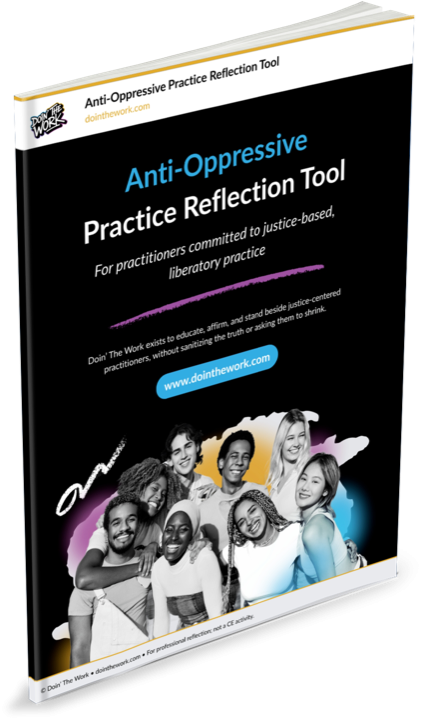
Free Anti-Oppressive Practice Reflection Tool
Understand how systems of power, privilege, and oppression shape our lives, our clients’ realities, and our professional decisions.
DOWNLOAD THE FREE TOOLCheck Out The Full Transcript
Shimon Cohen:
Welcome to Doin’ The Work: Frontline Stories of Social Change, where we bring these stories and real people working to address real issues. I am your host Shimon Cohen.
In this episode I talk with Keno Walker who is a youth organizer at Power U Center for Social Change in Miami, Florida. Keno is from Liberty City and has been involved with Power U since he was 13. He's now 23. We discussed Keno's work to organize black and brown youth around issues impacting their community such as the school to prison pipeline. Keno gives a first hand account of the crushing impact of racism and poverty on marginalized communities. He shares a story of how he got involved with Power U and his evolution in becoming an organizer. I hope you enjoy the conversation.
Hey Keno. Thanks for coming on doing the work. I really appreciate you taking the time and just to get us started off, maybe you could tell us a little bit about what you do at Power U.
Keno:
Okay, so I'm a youth organizer. I've been a youth organizer for the past two years and I am growing and developing young black and brown students to be thinking about the issues and what they're facing. That gets them to get their parents, their friends, their teachers, and the greater community involved in a way that they're taking leadership and organizing these folks to be moving in a direction that actually fits and look like what the community wants within the school, which ultimately pushes into the community. So right now we're tackling this on different fronts, but the one I'm working on is ... we have a committee that we started called Divest from Police Investments in Schools, DPIS, which allows us to go into schools, meet with teachers, meet with students. And teachers and students are having meetings, talking about funding. Right now there's a $22 million budget that our commissioners are putting it into for police officers. 103 armed police officers for the 2019-2020 school year. And we want that to not even be nowhere near finished. Right now, there's only in the visibility tests, testing right now.
But we're trying to figure out how do we create win by stopping that. That allows young people, teachers to actually envision what that money should go towards. Like right now, a lot of people are talking about how mental health is a big issue and what does trust counselors and higher pay wages for teachers look like? Why do we have officers within our schools when they're really not useful or there's no purpose for them to be there.
Shimon Cohen:
That's a lot that you're taking on and it sounds really interesting and we're going to get into a little bit of that in a minute. I'm curious, you were telling me earlier that you got involved when you were 13 years old and you've been involved for 10 years now. How did you first get involved and how is your kind of training in being able to do this evolved over the years?
Keno:
So my story is like a lot of other youth story. And then it's funny, but it actually starts to get really serious. So I got involved because I had nothing else to do. I was always at the house. My best friend, he told me about Power U, and I met the organizer at the time, which was the very first organizer, [Juliette 00:04:19] Daniels. And she got my mom to buy into it. And I went. The first month, we was going over restorative justice, which is the alternative to the school to prison pipeline. And we went through a whole training meeting, other young people and just getting me to buy into this whole idea or this whole framework of not suspending young black and brown students. And why is it important to keep them within the school without exiling them because of the harmful effect that happens and that actually pushes students from school to prison.
And I was like, "Yeah," I was all for it. I got super excited and then I went to my very first school board meeting and when I went there it was the worst thing ever. Our school board members, they didn't care what we said. They wasn't paying us no attention. Some of them was on the phone, some of them eating, some of them left, and then when we asked them to put restorative justice within our schools or at least start looking for funding to put restorative justice within our schools, they told us no. From then, frustration, aggravation, all this work that I put in. And me believing that the education system was actually for us. It definitely agitated me to want to be more involved in Power U and from then on I was like, "I'm a part of Power U."
And it kept me engaged and what kept me ... what my knowledge looked like, what my education looked like within Power U. We went to the US Social Forum that was in Detroit around that time. Going there meeting a whole lot of other young people that was talking about the same thing that was happening within my city that was happening in their city, and just building with them. Then for the summer Power U does this thing called College of Leadership, which allows us to learn about racism, homophobia. Helping learn about ... on gentrification, all these social issues that we're facing, that black and brown students face on a daily basis. But we do not know the name of it and we don't know how to call it out because it's so normalized. Being suspended out of school for 10 days is so normal.
Going to jail is so normal. Seeing police officers in your classes is so normal that we don't confront it or check it because we don't know the name and it's so normal to us that this is an everyday thing to us. Right? And when I was a youth ... and then from the going to Social Forum to going to College and Leadership, then I got an opportunity to go to this camping retreat type of training called ... that was held at the Highlander Center for Research. And they dive really good into just other social works that people are doing. People in Texas are doing a lot of immigration work or the people from North Carolina doing a lot of democracy working like domestic workers' work. And just being a part of that and like being in struggle with people.
Also just seeing how cool these people are, how beautiful these people are and I'm like, "Yo, I want to be just like them." So when I first started, I didn't know the language, I didn't know how to talk the language, I didn't know how to speak the language and I didn't know how to do the actions either, right? So after a while, just trying to really catch up and be on the same page as some people that I just met I thought was flipping amazing. I'm like, "Yo, these young people are amazing. I want to be just like them." And
I just grew from there. From a 13-year-old to 23, just understanding that the only way I can create change is by changing myself.
So how do I not hold patriarchy? How do I not hold homophobia? How do I be able to talk about gentrification and different things like that within my own home to also bring it out into the community.
Shimon Cohen:
What is that like when you're ... I guess before, I mean I know now, you're not in high school obviously and you're going into organized, but what was that like when you were still in school and you're learning all these things and like you said before, it was normal but you didn't have words to put to it, right? Now you're going into the school and you've got the words, what was that like with the other students? What was the response like?
Keno:
This is not the first time I have been asked this question because everybody ... when I'm organizing, I organize young people, and so people at my job or people around me like, "What's the difference from when you was a youth and then the difference from these guys now?" And my thing was technology wasn't ... we had cell phones and stuff but it wasn't as popping as it is now, right?
And also that they want the things. Me being organizer and me trying to break this connection, it was clicking for me but it wasn't clicking for everybody else, right? And that's only because of the fact that it's so normalized that it ... I'm trying to figure out how to talk about it because it's even a problem until today. It's that, I can go talk to young people and try to get them to be plugged in, but people are not trying to hear it just because of poverty and the situations that they live in. I had my mom and she took care of me and I didn't really need a lot of other stuff, so I had a lot of free time on my hands.
While there's kids that don't have the opportunity to have their mom around, or going through stuff that's even worse than me, or already have been touched by the juvenile system, right? So it was difficult to get other people involved. But we did our best. And I think what was super important that we did was throughout my childhood of being at Power U, we did a lot of surveying, in which we came out with a comic book. It talked about the school to prison pipeline. Black students are three times more likely to be suspended and arrested than white students while Latinx folks are 2.5 times more likely, right? I think that was our way to plug in, or that was my way to try to plug in young people that was going to school with me or my little brother or my friends or whoever I could. But I think the most effective way was just a lot of my closest friends.
Like right now it's me and my best friend and six of my close friends are still part of Power U, even though I'm 23, I'm the oldest out of all of them. There's 23, 22, 21, 20, 19, we're all still a part of Power U, we all still hold these same practices and principles and we still talk about the same social problems even though some of them are sous chefs or some of them are running food for restaurants or some of them are working at the football stadium. We're all doing ... I'm the only youth organizer for right now. But we're all doing different things, but we also have these practices and principles that we learned from Power U, that we're still talking about, and still trying to be in discussion with people about and not allowing people to just run over us or try to push us into these systems.
Shimon Cohen:
So one of the things I know that you all do at Power U, as you talk about how to build power, right? And to advance different agendas. Some of what you're talking about is when you're coming from a place where you don't feel like you have any power and then you start learning different ways to build power. It can, it can feel empowering, right? So how do you build power? How have you been able to have some of these campaigns be effective?
Keno:
When I was young and when I was inside of Power U, we didn't have victories until later on. The restorative justice victory, I started when I was 13 and I didn't get it 2015, right? So from 2008 to all the way to 2015, that's a long [inaudible 00:13:39] to wait. And the way we're trying to build power is we're not only engaging young people, we're getting teachers involved, we're getting parents involved, we're getting administration involved. We're going to talk to our commissioners and not really as a, "Oh I'm talking to you because I'm going to bash you or I'm going to attack you because you're not doing your job." But more of like, "What do we need to be doing? What do we need to do as a community, so you could give us what we need?" Right?
And that's how we building power. So right now we're doing a lot of civil engagement work. And our young people are getting paid to do canvas work. And they go out into the communities and we have six bullet points that talk about comprehensive sex ed and healthy sex courses that allows students to know not only about sex, but also about body autonomy. The word consent, what it feels like to know. To talk about abortion and have that as an option because our young teenagers are not sure what's happening with their bodies. And they are having sex and the more we tell them not to, that's not going to make it happen. And then we have a over fluctuation of pregnant teens or young men that are having babies and they don't know what the heck to do about it, right?
Also, we're talking about mental health work. So there's a lot of students that are hurt and that have been hurting other people and these are different points that we have on our platform that allows people to like, "Okay, this is what I believe in. This is what I believe in," and this is how we are engaging our people. This is how we engage in our community while educating black and brown students within the school. And right now I do school units within [Edison 00:15:43] and I go and talk to the teachers. I go and talk to students. We did some class reps and [inaudible 00:15:50] that. We're trying to get young people to be from all walks, all religion, all sexual orientation, all ethnic, to come and really dive in deep and think about what change should look and feel like for people of minority.
And not only that, but also people of lower classes, poor people. We're adopting the idea of [inaudible 00:16:23] race, like unification. There's a lot of poor white folks that's like on the same page as us. How do we engage these guys too, to create a world, create a society or community that actually fit in what we need. And I think our biggest way is just trying to grab people and plug them in. And that's by education, that's by figuring out what the problem is to figure out what the need is for people or the demand, and then how do we get these people, as people or voters to start thinking about voting, not on a national level, but more on a local level to be moving the politicians that's not fit in our needs or giving us our needs to actually put more people in power to get our needs. If not, then I think that's like where our new direction is or where we're going towards.
Shimon Cohen:
For you, what's the biggest challenge of doing this work?
Keno:
I would say money, or funds, and the time. Money and time also healing. Because our people are broken, our people are unknowing or unconsciously broken, and not willing to fight the fight because of money. Property is a real thing. How can I expect somebody to come out and be in a three hour meeting when they have to work? They had to work all day just to pay their bills. Right?
Shimon Cohen:
Mm-hmm (affirmative).
Keno:
People are broken, people need money and that's the two big things for me that really upsets people. And time too. How can I actually give people everything they need in a short amount of time. We only can have a two hour meetings with young people or two hour meetings with teachers or a two hour meeting with parents and things happen within their lives that actually also pushes them away from what we're doing. Like if their little brother gets shot or they just lost their house or their car. Or their kid just got suspended or arrested.
These things also become obstacles for them. Not only some people get more [inaudible 00:19:07] within the organization. And a lot of people are just like, "Damn, I can't do this and do that," right? So those are three major things that are the challenging things for me, within getting people to be more organized. And then also people have to be very clear and we as organizers have to be very clear that activism or activists are not organizers.
Yeah. Once you're [inaudible 00:19:43] you can get [inaudible 00:19:44] and like be all loud within movements or within actions, within rallies and things. But if you're not really trying to break down to a smaller level and creating real relationships with people and how you can hold each other accountable to create change and figure out self interests, not in the way of like trying to figure out like your own self interests, but figuring out self interests that intersects with other people. Self interest to get them more involved to be organizing or to be organized, it's going to be a challenge.
Shimon Cohen:
Where do things stand with restorative justice right now, with what you're doing?
Keno:
Yeah. So right now, we have so-called won. We won. They have been doing pilot programs within two of the schools that we know for sure and then trying do some in some high schools. So [Brownsville 00:20:49] Middle, they have restorative justice, which I heard is very well off. A close friend of mine, she goes there and she said, they're doing really good within it. And then they have one in [Homestead 00:21:03]. And then they're trying to do some in high schools. But the restorative justice is not what we think it should look like. And like that's also a point that I tried to mention is that we don't have clear wins. That's a win but it's not an authentic win that we can say that it's an overall, this is going to change something. And we also know that restorative justice isn't the end all be all, either. There's so much other stuff that we have to tackle, but we definitely think restorative justice is a part of our framework for our demands that allow us to create a real win for us.
So we definitely need restorative justice, but it's not the end all be all. We need this to be in place, to allow us to hold people accountable while not exiling them. So we can get mental health workers, or we can get trust counselors. Or we could get extra-curricular classes for our students, or we could get comprehensive sex ed classes for our young people. Which all these things, if you're learning within your school at a young age, this is something that that you carry these principles and practices that you carry through. When you get into the community and you get your job, so you go to college or whatever, you start your career, whatever it is, you still hold these principles and practices that allow you to better your community.
Shimon Cohen:
I'm going to link in the show notes on the podcast, I'm going to link to the Power U website so people can go there to learn more about everything you're talking about. A lot of the listeners of the podcast are social work students, educators, social workers. I want to just give you an opportunity to kind of reach out to the listeners and with whatever you want to get across. Use this as an opportunity as a platform.
Keno:
Okay. So want to first off by saying that I appreciate that you guys are even getting into this work because it definitely takes a lot of mental stability and a lot of love and care for people. And I also want to encourage you guys to also start thinking about what it looks like to not only be a service but also thinking about how do we get to be more on becoming the education for community developers, right?
Because there's a big thin line that you cannot cross, right? When it comes to mental health to how to organize people. Especially when it comes to funding and grants and where you work at. So I really want you guys to be thinking about what is the connection and how do we bridge these two things, right? So not only thinking about yourself as service or mental health workers, right? But also how are we connecting this work to community? How are we connecting this work to the systematic problems that's happening within our communities, right? And what is a real way to bridge these connections? How do we not only heal our people but also engage them into for our fight. And that's not a physical fight but more of a fight to have their land, a fight to have their community, a fight to have what they need, a fight to have their resources.
It's really easy to use a people but it's really hard to replenish or rejuvenate people. And I think you guys do a really great job at trying to find out what that looks like. And really show that you care. But also, our system that we work in, that we live in, isn't for us. It doesn't look like us and it and it doesn't fit us. So how do we step out of this box? How do we step out of this system and really create something that's going to look and feel like us. I want to see you guys at Power U. We have a lot of our students go through different situations on a daily basis that me as youth organizer that hasn't done social work or hasn't done any therapy, hasn't done any mental justice work.
Other than the being able to identify what these isms are or other than how to identify what social injustices are. I think you guys will play a big role in what we do within our community and just be super engaged and be open to the idea of really engaging with it, with the community on more of a critical but radical level.
Shimon Cohen:
That's great, Keno. Man, I really appreciate you coming on here and taking the time and for doing the work. I mean you're out there doing the work every day.
Keno:
Mm-hmm (affirmative).
Shimon Cohen:
What's next for you?
Keno:
So my idea is to keep working at Power U as long as they need me, as long as I need to be there. But my objective is to be able to create a program that talks about healing, a holistic healing that rejuvenates our organizers or our young people that that wants to be organized or organizers have the [inaudible 00:27:13] that's been organizing for a while because this takes a lot of work and it definitely put a strain on our ability to withstand and we get overworked, we get burnt out, and all of these different things.
So I want to create a training, which allows people to be rejuvenated. And doing that in the frame of art. How do we create an art piece, which is visual art, which is just dance, music, poetry, whatever that looks like. Whatever the art form looks like. How do we create this art piece and understand what healing looks like to me. So I can always use this art piece or look at this art piece or dance this art piece or sing or say this art piece that allows me to be rejuvenated. I can not only understand what my art piece means to me, but how it moves me to be ... how to rejuvenate me to be where I need to be at and what I need to be doing. Which also kind of funnels young black and brown students within ... from these art programs to be funneled into organizing movement.
I want to do this internationally. It's not like a local thing. I want to do this internationally. So I'm going around and just teaching young people about healing within art. So if I'm in Chicago, how am I like connecting Chicago artists, Chicago organizers to help me fulfill this program, for how long would it be, and then allow students to be plugged in within organizations. Actually thinking about radical changes, right? So healing but also funneling young people into organizations to think about what would it looks like to be an organizer.
Shimon Cohen:
That's cool. And I hope if some people are listening and that's something they're interested in, because we have listeners all over the country and some international, get in touch with Keno. I'm going to put his contact information in the show notes and you can reach out to him.
And Keno, again, I want to just thank you for coming on the podcast and for doing the work.
Keno:
Yeah. Thank you so much guys.
Shimon Cohen:
Thank you for listening to Doin’ The Work: Frontline Stories of Social Change. I hope you enjoyed the podcast. Please follow on Twitter and leave positive reviews on iTunes. If you're interested in being a guest or know someone who's doing great work, please get in touch and thank you for doing real work to make this world a better place.
Music credit:
“District Four” Kevin MacLeod (incompetech.com)
Licensed under Creative Commons: By Attribution 4.0 License
https://creativecommons.org/licenses/by/4.0/